
Need for Speed Underground
Related Games





Description
Overview of Need for Speed Underground for PC
Need for Speed Underground is a racing game developed by EA Black Box and published by Electronic Arts, and it represents one of the most radical and influential shifts in the long-running franchise’s history. Released in 2003 for PC, the game moves away from exotic supercars and scenic daytime tracks, instead diving headfirst into the world of illegal street racing, underground car culture, and nocturnal urban aesthetics inspired by early 2000s tuner trends. You begin as an unknown driver, slowly earning respect through victories, sponsorships, and increasingly flashy cars, rather than saving the world or chasing a cinematic storyline.
What makes Need for Speed Underground especially important is how clearly it distances itself from the formula established by the previous installment, Need for Speed: Hot Pursuit 2, which focused on supercars, police chases, and high-speed racing on legal tracks. Underground deliberately removes police pursuits and replaces them with reputation, style, and personal expression, effectively redefining what a Need for Speed game could be. This creative gamble paid off by creating an identity that felt fresh, rebellious, and closely tied to the car culture of its era.
Need for Speed Underground Features
One of the most defining features of Need for Speed Underground is its extensive and visually driven car customization system, which was groundbreaking at the time and remains iconic today. Players can modify body kits, spoilers, hoods, rims, vinyls, paint finishes, neon lights, and even interior details, transforming everyday cars into exaggerated street racing machines. These changes are not just cosmetic distractions, because the game actively evaluates your car’s visual rating and often requires specific upgrades to unlock events or secure sponsorships.
Style as Progression
Unlike earlier racing games where upgrades were purely about performance, Underground makes style an integral part of progression and success. Visual upgrades contribute to your reputation, which directly affects career advancement and unlocks special events. This system reinforces the fantasy of underground street racing, where looking impressive can matter just as much as crossing the finish line first.
Another important feature is the structured career mode that replaces open-ended arcade progression with a carefully paced journey through the underground racing scene. You are guided through increasingly challenging events, gradually unlocking new cars, parts, and race types. The game constantly introduces new mechanics at a comfortable rhythm, ensuring that players always feel a sense of forward momentum without being overwhelmed by options or complexity.
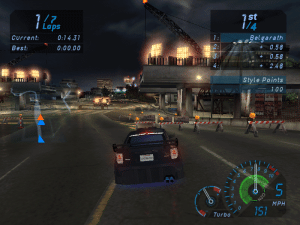
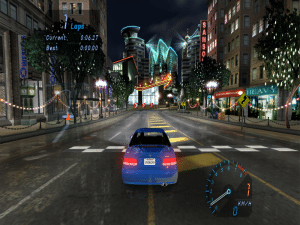
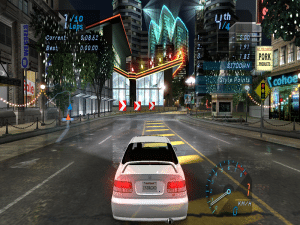
The audiovisual presentation further strengthens the game’s identity, especially through its soundtrack and lighting design. The music selection blends electronic, hip-hop, and rock tracks that perfectly match the energy of night racing. Combined with neon reflections, wet asphalt, and exaggerated motion blur, every race feels like it takes place inside a stylized urban dream rather than a realistic city.
Gameplay
Core Racing Mechanics
The gameplay of Need for Speed Underground focuses on fast, accessible arcade racing that prioritizes flow, aggression, and spectacle over strict simulation realism. Cars are responsive and forgiving, allowing players to take corners at high speed while still rewarding good racing lines and smart nitrous usage. Crashes look dramatic but rarely feel overly punishing, which keeps races exciting rather than frustrating.
In contrast to Need for Speed: Hot Pursuit 2, where pure speed and police chases defined the experience, gameplay here emphasizes aggressive night racing, vehicle control, and steadily building street reputation within a closed underground scene. This shift changes the tone entirely, making every race feel more personal and grounded in car culture rather than spectacle-driven law enforcement drama.
The handling model strikes a balance between accessibility and depth, making the game easy to pick up while still allowing experienced players to optimize performance through tuning and car selection. Each vehicle feels slightly different, and upgrades subtly influence acceleration, top speed, and cornering behavior.
Race Types and Variety
- Circuit races reward consistency and positioning across multiple laps.
- Sprint races focus on point-to-point speed and risky overtakes.
- Drag races emphasize timing, gear shifts, and lane control.
- Drift events reward controlled sliding and maintaining angle.
- Knockout tournaments apply constant pressure by eliminating racers each lap.
Each race type introduces a distinct rhythm, preventing the career mode from becoming repetitive despite the reuse of urban environments. Drag and drift modes feel particularly experimental for their time, showing a willingness to expand beyond traditional racing formats.
Progression and Customization Loop
Progression in Need for Speed Underground revolves around a satisfying loop of racing, unlocking parts, customizing your car, and using those upgrades to access tougher events. Every new visual or performance part feels meaningful, especially because many are required to meet sponsorship objectives or unlock special races. This structure ensures that customization always feels purposeful rather than optional.
Career milestones are clearly defined, giving players constant short-term goals while steadily pushing them toward long-term dominance. The pacing rarely allows the experience to stagnate, as new cars, challenges, and rewards appear frequently enough to maintain excitement and motivation.
Pros and Cons
Pros
- Deep and iconic customization system that turns cars into personal statements.
- Strong progression structure that rewards both skill and visual creativity.
- Wide variety of race types that keep gameplay fresh and engaging.
- Memorable soundtrack and atmosphere that capture early 2000s tuner culture perfectly.
Cons
- Lack of open-world exploration makes environments feel restrictive over time.
- Minimal narrative depth beyond basic career progression.
- AI rubber-banding can occasionally feel unfair in later events.
SYSTEM REQUIREMENTS
OS: Windows 98 / ME / 2000 / XP
Processor: 700 MHz Intel Pentium III or equivalent
Memory: 128 MB RAM (256 MB recommended)
Graphics: 32 MB DirectX-compatible GPU (e.g., GeForce2 or ATI Radeon 7500)
DirectX: Version 8.1
Storage: 2 GB available space
Game Info
Genre: Racing
Developer: Electronic Arts
Platform: PC
Game Size: 2 GB
Released By: MnSXx, cs.rin.ru
Version: v1.4
Installed Game
Images












amazing old game thx!